
EPACK Durable
When Seasons Turn: EPACK’s Journey from Cooling Woes to Widening Horizons

Business
EPACK Durables Limited is India’s second-largest Original Design Manufacturer (ODM) for Room Air Conditioners (RACs).
Historically, the company’s performance was overwhelmingly tied to the highly seasonal RAC market. This over-exposure proved to be a significant vulnerability, leading to severe performance downturns in FY24 and FY26, which were triggered by unseasonal weather patterns and resulting inventory gluts in the sales channel.
In response, management has executed a rapid and necessary diversification strategy, aggressively growing its businesses in Small Domestic Appliances (SDA), Large Domestic Appliances (LDA), and high-margin Components. This pivot is needed to hedging against the volatility of the core RAC segment.
The company is now at a critical inflection point. Future growth is almost entirely dependent on the successful execution of two massive, capital-intensive projects:
A strategic manufacturing partnership with the global electronics giant Hisense to produce air conditioners and washing machines.
A joint venture, EPAVO, for the in-house manufacturing of critical components, specifically BLDC motors.
EPACK Durables has successfully navigated severe market headwinds in the first half of FY26. Its future success now hinges on executing these large-scale capital expenditure projects on time and on budget. While the core RAC business remains a double digit growing market, the diversification efforts are still needed to be an effective and essential counter-balance.
Founders, Management, and Corporate History
A Legacy in Manufacturing: The Singhania and Bothra Families
The company’s roots in manufacturing are deep, though they did not begin in consumer durables. The founding families, the Singhanias (brothers Ajay and Sanjay) and the Bothras, established EPACK Polymers in 1999. This initial venture was a packaging firm, primarily manufacturing thermocol and other packaging materials for large electronics companies like LG.
A strategic opportunity presented itself in 2003. After learning that LG was seeking regional partners to assemble its products, the families founded EPACK Durables. The new company established an air conditioning plant in Dehradun and, for the next decade, operated as an exclusive assembler for LG, handling ACs, microwave ovens, and other appliances. This exclusive relationship provided a deep, ten-year apprenticeship in the appliance industry.
In 2012, having built significant manufacturing expertise, the company branched out to begin manufacturing for other brands, evolving its business model from a simple assembler to a design-led partner.
The Business Model: Manufacturing for the Brands
What is an ODM & OEM?
To understand EPACK, one must first understand the difference between an OEM and an ODM, as the company operates as both but is strategically focused on being an ODM.
OEM (Original Equipment Manufacturer): This is a simple contract manufacturing model. A brand (like Voltas) approaches EPACK with a complete, finished design for an air conditioner and says, “Build this for me.” EPACK acts purely as a “pair of hands,” assembling the product exactly to the client’s specifications.
ODM (Original Design Manufacturer): This is EPACK’s primary and more advanced business model. EPACK’s own R&D centers design and develop entire product platforms, for example, a new, energy-efficient inverter AC or a new type of air fryer. EPACK then presents this “white-label” product to brands like Haier or Philips. The brand can then select the product, request minor modifications (like a new front panel, different colors, or adding their logo), and sell it as their own.
This ODM model is superior because it embeds EPACK into the client’s R&D and product development cycle. This creates “stickier” customer relationships, reduces the client’s R&D costs, and allows for better margins.
How EPACK Helps Customers: A Brand’s “Factory-in-Reserve”
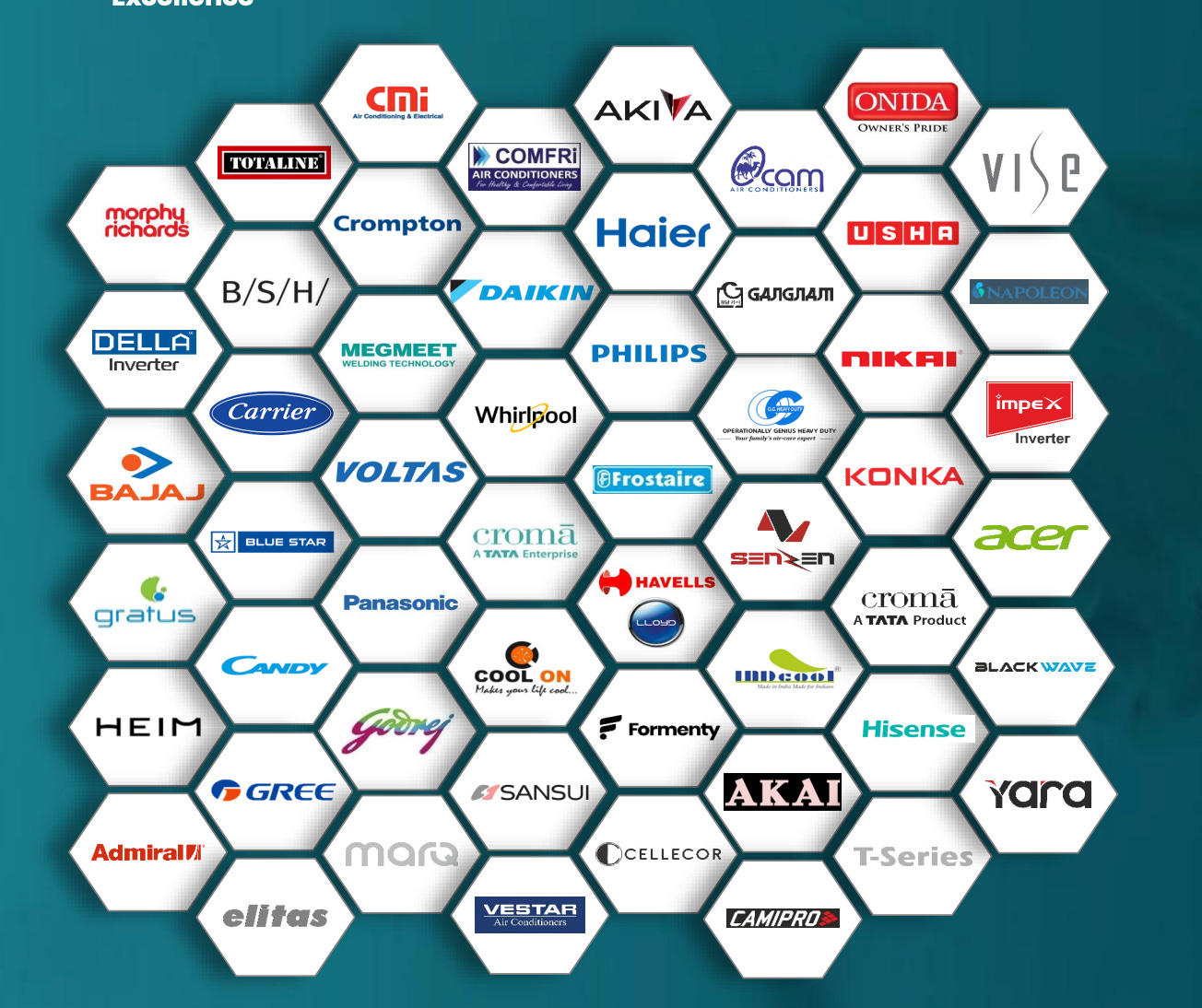
EPACK functions as a capital-light solution for major consumer durable brands. For a customer like Daikin or Panasonic, launching a new product category - such as an air cooler or a washing machine, is a massive undertaking that would typically require hundreds of crores in capital expenditure to build a new factory.
By partnering with EPACK, the brand can bypass this. EPACK provides the existing R&D capabilities (with 3 NABL-certified labs), the “manufacturing prowess” across its three large facilities (Dehradun, Bhiwadi, Sri City), and an established component ecosystem. This allows the brand to launch a new product in months, not years, while focusing its own capital on marketing, distribution, and brand-building.
Business Segments
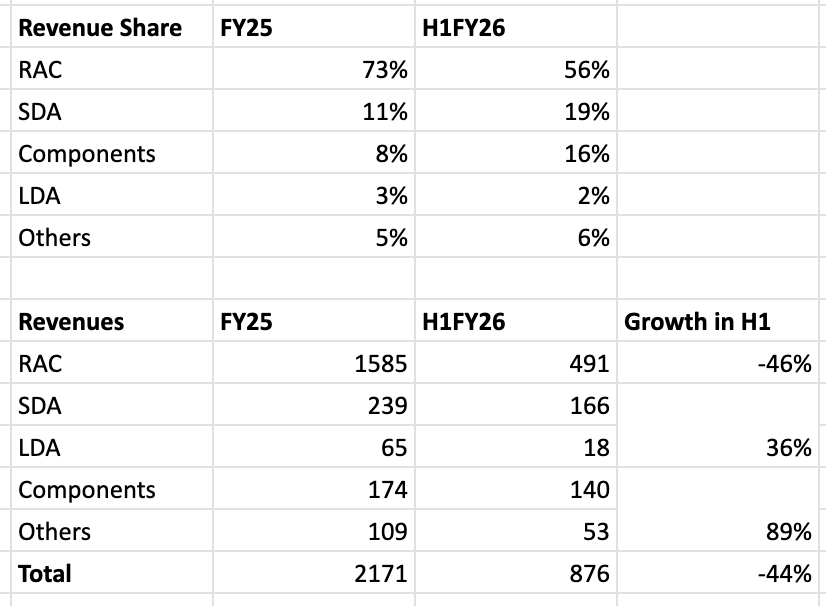
The company’s revenue model is best understood by looking at its four operating segments. The strategic shift in the revenue mix between these segments is the most important trend in the company’s recent history, as it demonstrates the successful execution of its diversification strategy.
Company now operates mainly in three segments -
RACs (Room Air Conditioners)
SDA & LDA (Appliances category)
Components & Others
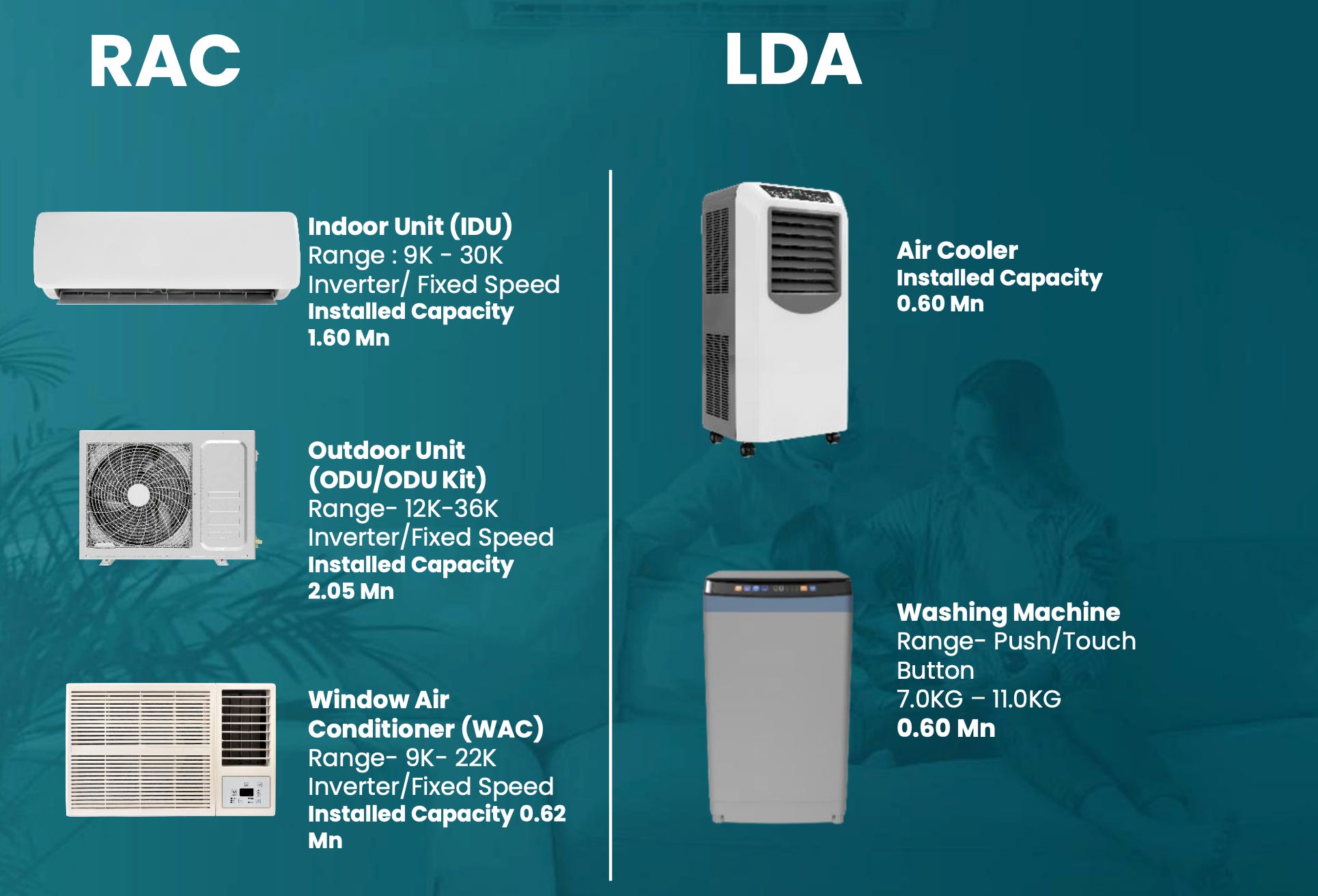
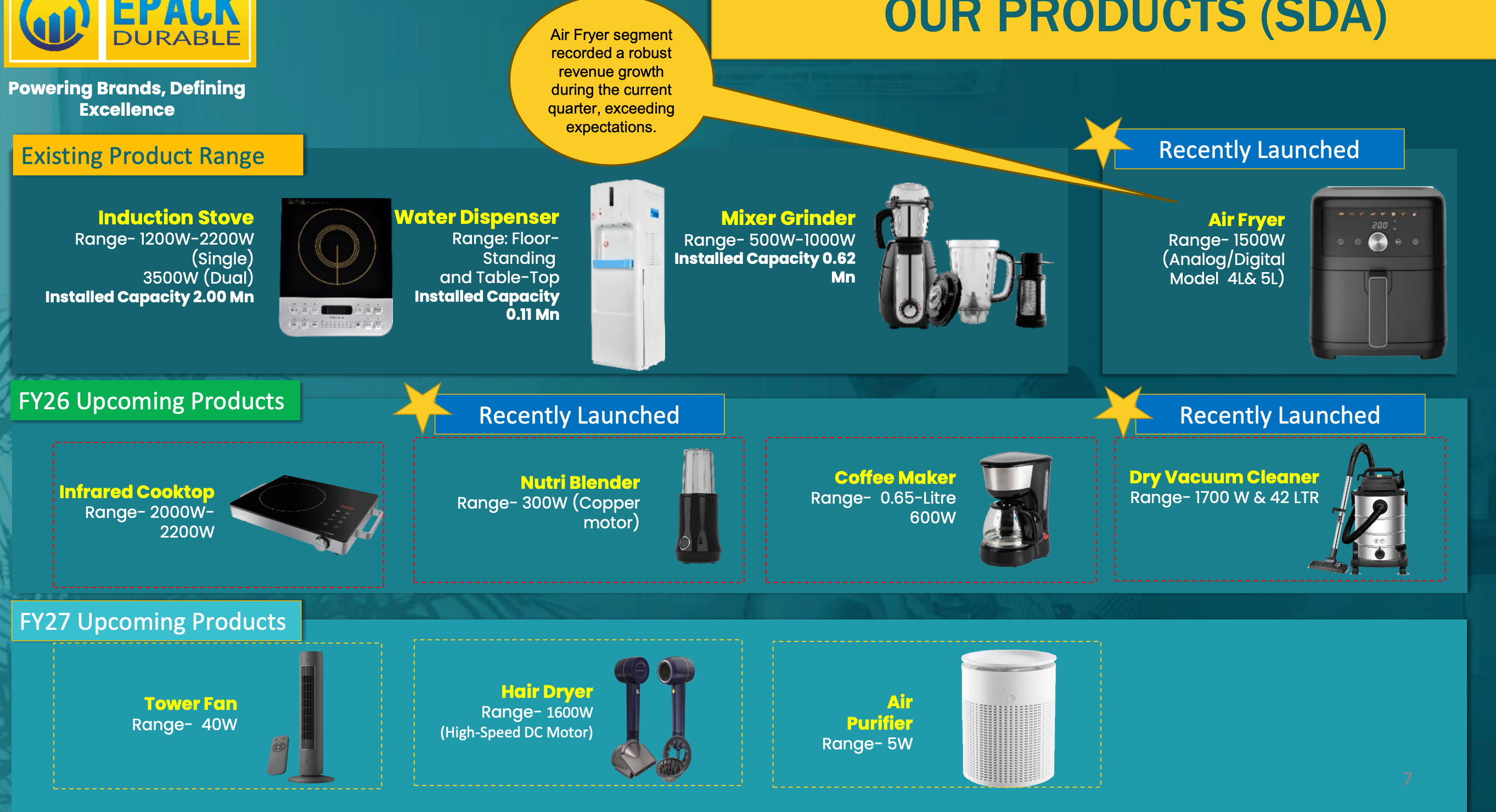
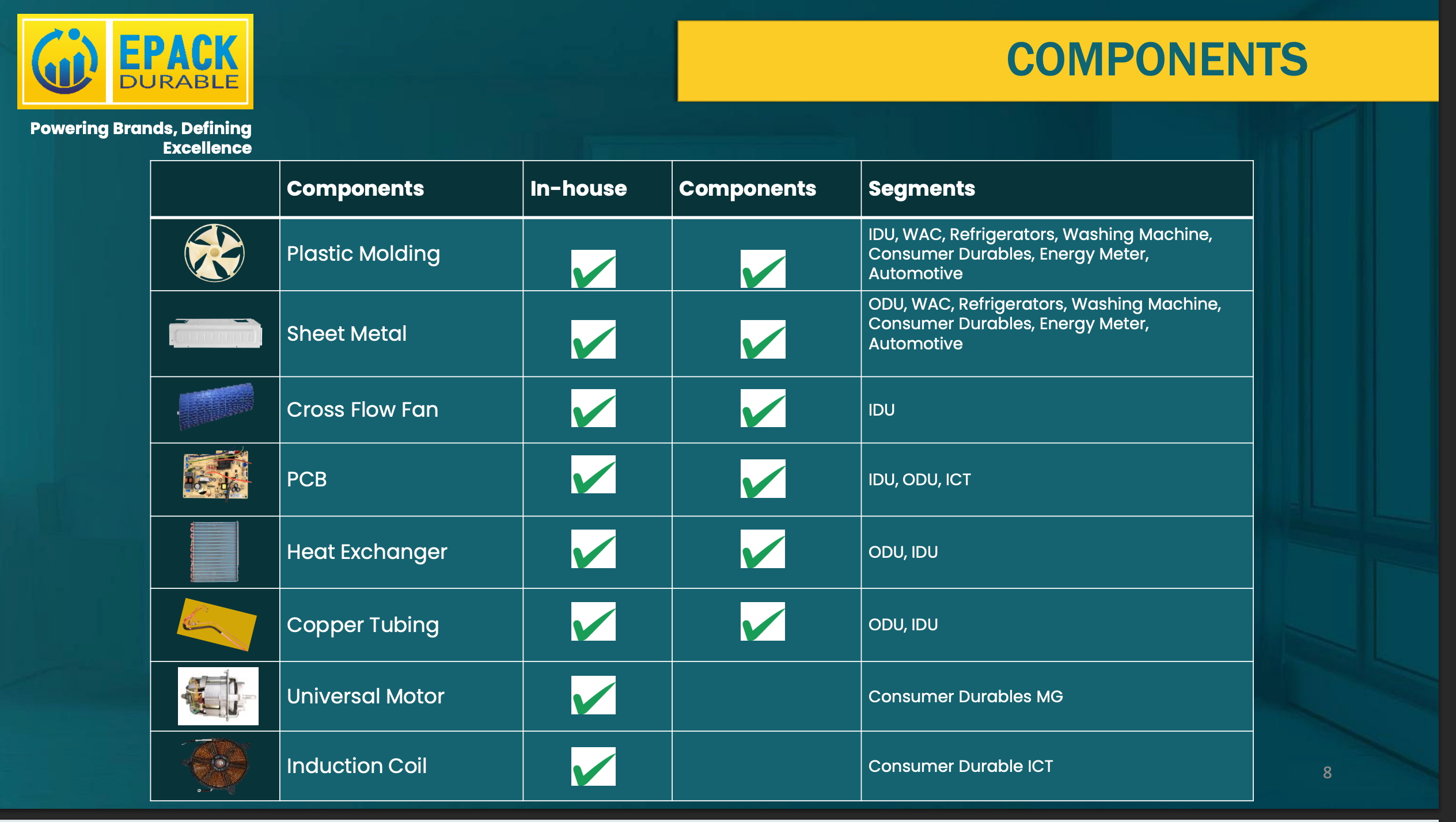
While RACs have been dominant category in the business, the overall share of them would reduce over the period of time.
Financial Analysis and Current Health
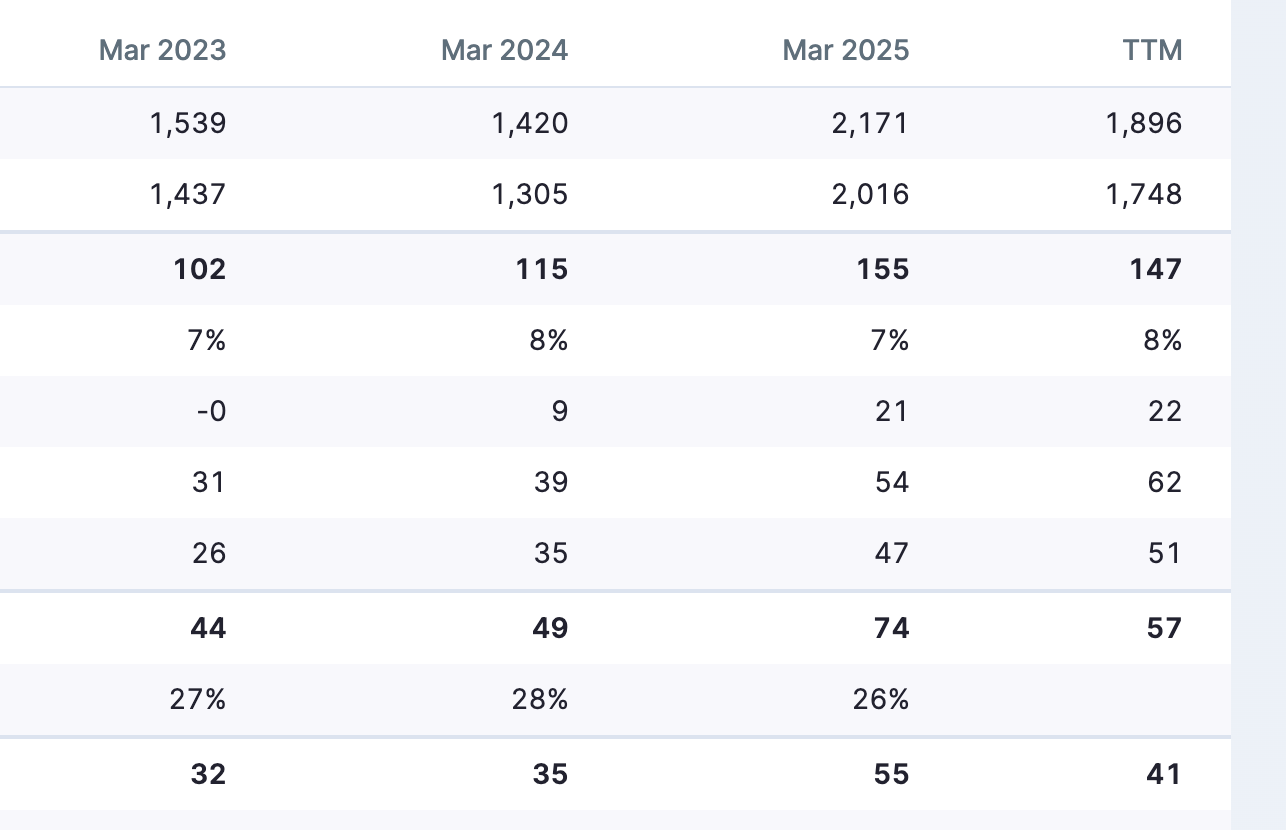
EPACK faced headwinds in FY24 due to erratic monsoon and customer loss where certain customer moved production in-house
FY25 was a rebound year where almost 50% growth was recorded
FY26 has been year of higher monsoon again and it has impacted the performance of the company severly.
The silver lining in this has been the margins of the company which have inched up. This is due to the fact that the newer business especially components and some appliances are higher margin in nature.
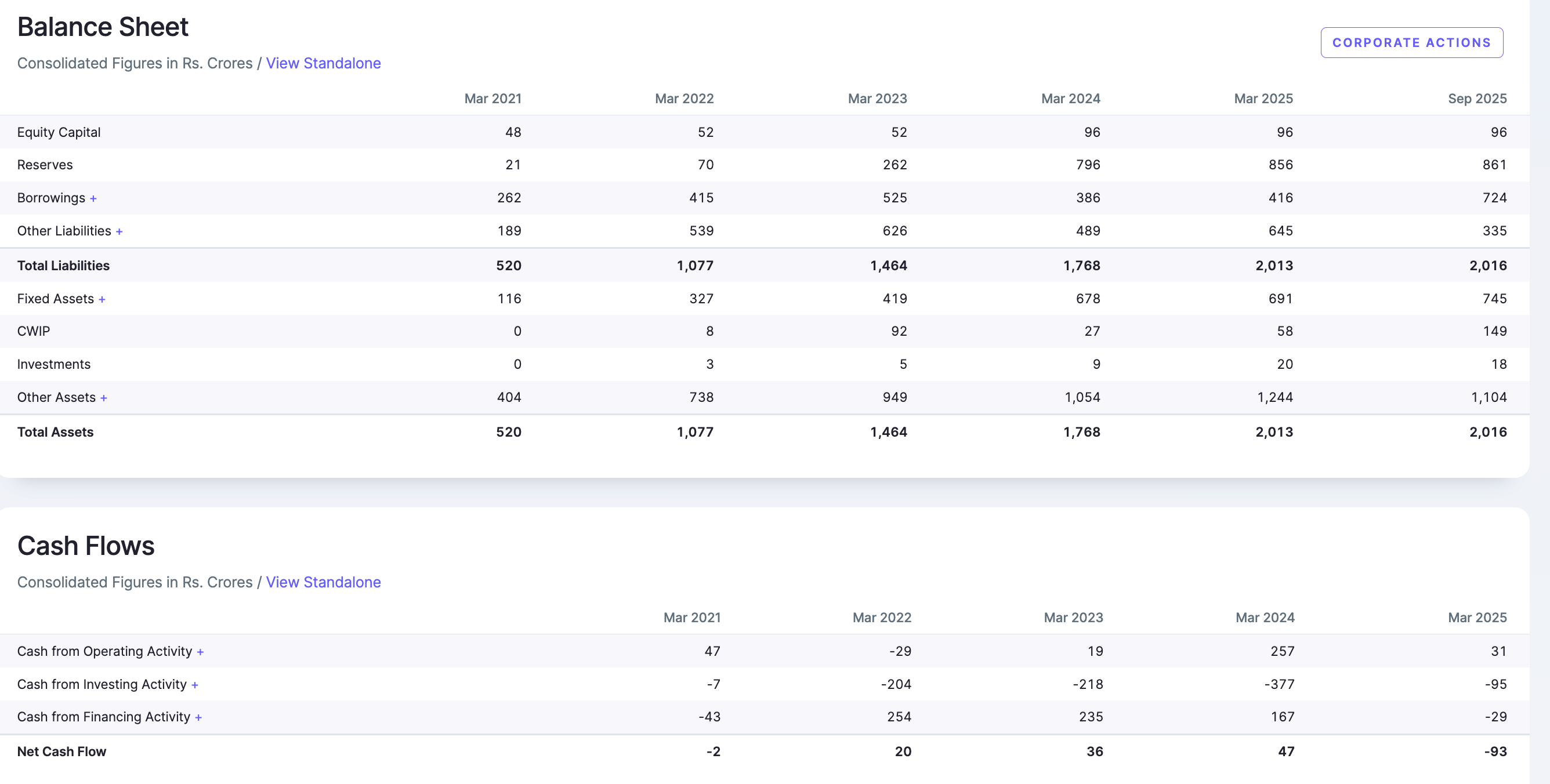
While the company seems to manage cash flows well and keeping working capital in check, there is some uptick in gross debt levels that needs to be tracked.
Growth Outlook
The company’s future growth is defined by various initiatives and partnerships:
The Hisense Partnership (Wholly Owned Subsidiary)
This is the single most significant growth driver. EPACK has established a new wholly-owned subsidiary, EPACK Manufacturing Private Limited, to build and operate a dedicated manufacturing facility for the global giant Hisense.
The Target: Management has guided that this partnership is anticipated to deliver “$1 billion in cumulative revenue over five years”.
The Products: The facility will produce Hisense-designed RACs and washing machines. This is a crucial step into manufacturing for export, as the products are intended for both the Indian market and export to the Middle East and Africa.
The Timeline: The ramp of this plant should start in Q3/Q4 this year.
The EPAVO JV (Backward Integration)
This is a 50:50 joint venture with the Ram Ratna Group to build a greenfield facility for manufacturing BLDC (Brushless Direct Current) motors.
The Strategy: This is a classic backward integration play. BLDC motors are a critical, high-value component for modern inverter ACs. The plant is planned to produce 3 million AC motors and 1 million ceiling fan motors, capturing an estimated 10% of the total Indian market demand. This move achieves two goals: (1) it provides EPACK with a secure, in-house supply of a critical component, and (2) it opens a new, high-margin revenue stream by selling these motors to other appliance brands.
This JV company is producing BLDC motors for three segments i.e. Air conditioners, Ceiling fans and HVLS fans. The Company also plans to produce other product segments i.e. induction motors, universal
The Timeline: The production here has started recently in Q2.
The Emerging Segments (SDA and LDA)
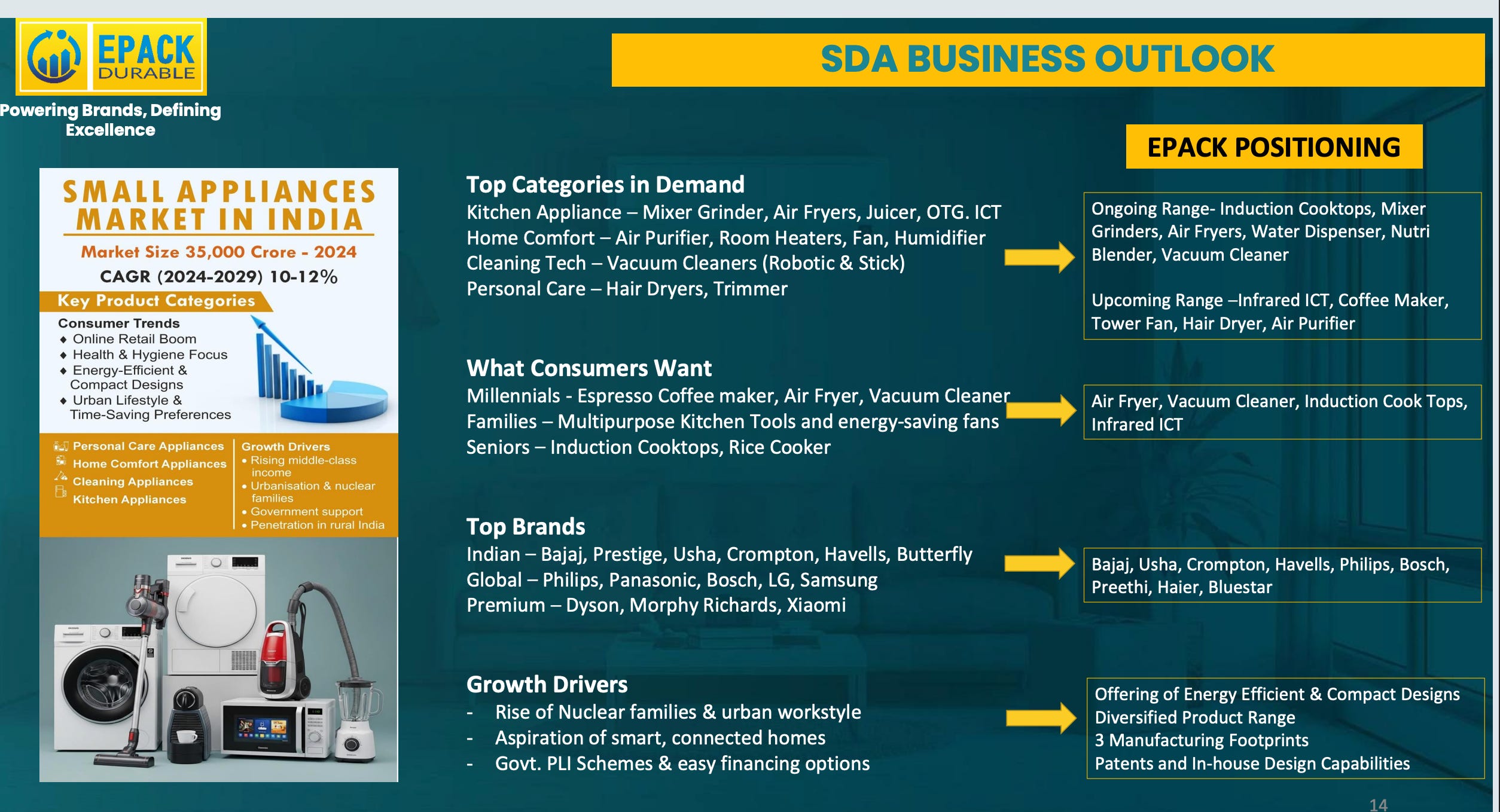
This pillar represents the company’s organic diversification. The company is aggressively launching new products to reduce its reliance on ACs.
Products: The new product pipeline includes air fryers, nutri blenders, coffee makers, and dry vacuum cleaners. In Large Domestic Appliances, the major launch is washing machines.
Additionally they have also shared plans of getting into audio products.
Status: As of the Q2 FY26 concall, management confirmed that air fryers, vacuum cleaners, coffee makers, and blenders were all in the production ramp-up phase.
Getting deep in the components landscape
Company has tie-up with Panasonic & Daikin and other RAC manufactures to produce PCBA controllers and Copper components for RACs.
This Strategic move will enable the company to enter the EMS business, focusing on the manufacturing of critical components such as PCBA controllers, heat exchangers, CFFs, Copper Parts and molded parts, leveraging the benefits of the PLI scheme.
Riding on RAC growing market
While FY26 was a bad year for RACs, the industry is still set to grow in high teens in next 5 years.
EPACK aims to outgrow the industry going forward and hence this business remains a very important lever to drive any shareholder value.
Risks in the business
Customer Concentration
Currently 2 customers make 45% of revenue and this is a major risk to the business but it is coming down due to diversification efforts by the company.
Execution Risk: Capex, Ramp-Up, and Margin Drag
The company is investing heavily (approx. ₹500 crores) in new projects. These projects must generate revenue on time to justify the cost so that they can pay debt without harming financials further.
In-Sourcing by end customers
Management explicitly admitted that a large client building its own factory was a key reason for the FY24 revenue decline. This risk always looms, as any brand that achieves sufficient scale may choose to “in-source” manufacturing, cutting EPACK out.
Availability of certain components
The “heart” of an AC is largely imported. The government has granted a one-year “respite” on BIS certification for compressor imports. If this is not extended or if domestic capacity lags behind, the entire industry could face a critical component shortage. Any such re-occurrence in some other component can create temporary hiccups.
Rare-earth shortages can also cause issues for any player in EMS ecosystem.
Execution issues at customer end
Any execution issues at customer level can cause problems at EPACK since EPACK does lot of chunky business for few customers.
Competition
No industry is without competition and EMS industry is definitely filled with all kinds of players eyeing for market share as ODMs and OEMs in similar products.
Summary & Valuations
EPACK delivered ₹2,170 crore revenue in FY25, and management had guided for 35%+ growth in FY26. However, an unusually weak summer and a sluggish RAC industry have derailed those expectations. FY26 numbers will likely fall well short of that target. That said, summer demand will eventually return, and the next year could mark a strong rebound for the air-conditioning segment.
Over the long term, EPACK’s RAC business should compound at 20–25% CAGR, in line with (and slightly ahead of) the broader industry growth of ~15%. On top of that, the company’s SDA, LDA, and component divisions are scaling rapidly, providing incremental growth levers. The HiSense partnership expected to contribute about $1 billion (~₹8,000 crore) in cumulative revenue over five years, could alone add around ₹1,000 crore by FY27–FY28.
Putting all of this together, EPACK appears well-placed to reach ~₹5,000 crore revenue by around FY28, assuming steady execution. With a better product mix and operating leverage kicking in, PAT margins could expand to ~3%, implying ₹150 crore PAT potential by that time.
On valuations, EMS peers have commanded premium multiples given their non-linear growth trajectories. If EPACK sustains similar momentum, this ₹150 crore PAT could translate into significant upside. Still, rather than entering purely on fundamentals, I’d prefer to wait for technical confirmation before taking a position.
Disclaimer: I am NOT a registered advisor or a financial adviser. Any information I share on my blog are provided for educational purposes only and do not constitute specific financial, trading or investment advice. I may or may not be invested at time of writing the blog or later on. The blog is intended to provide educational information only and does not attempt to give you advice that relates to your specific circumstances. You should discuss your specific requirements and situation with a qualified financial adviser.